
Project Management Case Study:
Scaling Client Systems Implementation Across Multiple Industries
Project Overview
-
Organization:
-
Kay + Co. Studio
-
-
Role:
-
Founder
-
Project Manager
-
Systems Architect
-
-
Timeline:
-
2019-2024 (Peak operations in 2021)
-
-
Team:
-
8 subcontractors + 1 Online Business Manager at peak
-
3 CRM specialists
-
2 designers
-
3 copywriters
-
1 OBM
-
-
-
Tools:
-
ClickUp
-
Dubsado/HoneyBook
-
Slack, Zoom
-
Zapier
-
Google Drive
-
Canva
-
-
Project Type:
-
Portfolio program - managing 120+ client implementations across coaches, photographers, wedding vendors, accountants, and designers
-
Business Context & Objectives
The Market Opportunity
Creative service providers, photographers, wedding vendors, coaches, and designers were drowning in manual administrative work. They were spending 15-20 hours per week on tasks like sending proposals, contracts, invoices, and follow-up emails. Most were piecing together disconnected tools (PDFs for proposals, DocuSign for contracts, Stripe for payments), creating a disjointed client experience and consuming their billable time.
These business owners knew CRM platforms like HoneyBook and Dubsado could solve their problems, but they lacked the time and technical expertise to set up complex automation workflows. DIY approaches were taking weeks or months of trial and error, with most giving up halfway through.
I recognized a gap: creative entrepreneurs needed done-for-you CRM implementation customized to their specific business processes, not generic templates. Having built these systems for my own freelance design business in 2016 and received consistent feedback that "you should do this for others," I launched Kay + Co. Studio to fill this need.
Program Constraints & Scale
-
Volume: Managing 44+ client implementations while maintaining quality and customization
-
Timeline: Each client project ran 6 weeks, with multiple concurrent implementations
-
Team scaling: Growing from solo operation to 8-person contractor team while maintaining quality standards
-
Industry diversity: Adapting core methodology across vastly different business models and workflows
Goals & Success Metrics
-
Business goal: Generate $200,000+ in revenue (achieved $200K+ gross volume 2020-2022)
-
Client outcome goal: Save 15-20 hours per week per client on administrative tasks
-
Quality goal: Maintain high client satisfaction across all implementations (measured by referrals and testimonials)
-
Scalability goal: Create repeatable processes allowing team growth without quality degradation
Scope, Approach & Execution
Service Scope: The VIP Weekend Model
I developed a productized service, the "VIP Weekend", that delivered complete, custom CRM systems in six weeks. The offering included:
-
6-9 workflows built in HoneyBook or Dubsado (client's platform choice)
-
Custom email templates (~20 per client, ~5 per workflow)
-
Branded graphics for in-platform forms, PDF service guides, proposals
-
Complete platform setup: appointment templates, questionnaires, contracts, packages, payment plans, payment reminders
-
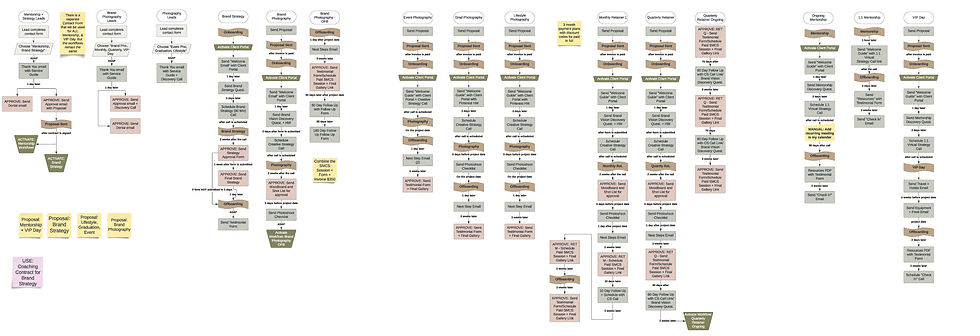
Workflow maps (color-coded flowcharts) showing complete business processes
-
Training video walking through complete system
-
Written SOPs (optional add-on purchased by 25% of clients)
Sample Client Workflow Maps


Pricing Evolution
Service pricing evolved based on scope management learnings:
-
Initial: 3 workflows for $799
-
Evolution: 4 workflows for $1,600 → $1,950 → $2,250
-
Final model: Unlimited workflows for 3 complete services at $2,500 → $2,990 → $3,500
-
Sweet spot: $1,600-$2,500 range saw highest conversion and volume
The shift from workflow-based to service-based pricing eliminated scope creep issues by removing arbitrary workflow limits.
Delivery Approach: Standardized Yet Customized
I created a repeatable six-week methodology that maintained customization:
-
Weeks 1-3: Client Discovery
-
Clients completed three homework assignments: company details questionnaire, process questionnaire, proposal/service guide content workbook
-
I reviewed process lists and created workflow maps showing each automation step
-
Held a 60-minute recorded workflow mapping call to finalize strategy and surface hidden needs.
-
-
Weeks 4-6: Content Creation
-
Copywriters drafted all emails using workflow mapping call recording and flowcharts as source material
-
Designers created branded graphics for forms, proposals, and service guides
-
Presented all assets to client 5 days before VIP Weekend with 2-day review window and 3-day edit buffer
-
-
Week 6: VIP Weekend Build
-
Friday: CRM assistant added all content into platform (emails, meeting types, forms)
-
Saturday: Built complete workflows connecting all pieces; OBM reviewed using build checklist
-
Sunday: My final review against checklist; recorded training video; delivered system
-
Project Management Systems & Tools
ClickUp Workspace Architecture:
-
Each client had dedicated project with templated task lists, subtasks, custom fields, due dates
-
Team members assigned to specific tasks with clear accountability
-
Initially tried giving clients ClickUp access but found it too complicated; switched to Slack for client communication
Automation Infrastructure:
-
Zapier automation triggered on payment (via ThriveCart)
-
Created templated Google Drive folder with 2 subfolders
-
Created Slack channel for client
-
Duplicated ClickUp project template
-
Waited 3 days, then sent $10 Starbucks gift card as homework fuel
Quality Control Systems:
-
Build checklist showing order of platform setup tasks and review checkpoints
-
OBM review checkpoint with documented feedback space
-
Final review checklist I completed before client delivery
Industries Served & Adaptation
While the core methodology remained consistent, I adapted workflows for diverse industries:
-
Coaches: Grief, life, career, online business (multiple session packages, program enrollment workflows)
-
Photographers: Branding and wedding (inquiry → shoot → delivery workflows with gallery management)
-
Wedding Vendors: Venues, florists, custom ring makers, bakers, planners (event-based workflows with multiple touchpoints)
-
Service Providers: Accountants, copywriters, designers (project-based workflows)
Leadership, Risk & Decision-Making
My Role & Leadership Approach
As founder and project manager, I maintained dual responsibilities:
-
Client-Facing: Sole point of contact for all marketing, sales, discovery, strategy, and delivery
-
Team Management: Led 8-person contractor team at peak while handling own client systems and internal operations
-
Quality Oversight: Positioned myself as final checkpoint, recognizing "no one was going to care more about my business and reputation than me"
-
Process Architect: Continuously refined methodology based on patterns across implementations
Kay + Co. Studio Organization Chart

Dubsado Leads Sources

Challenge 1: Initial Scope Creep
-
Risk:
-
Clients needed more workflows than service packages allowed. I didn't want them leaving without tools their business needed, but giving away extra work hurt profitability.
-
-
Decision:
-
I restructured the service offering from workflow-based pricing to service-based pricing, eliminating the arbitrary workflow limit while protecting scope through better contracts.
-
-
Tradeoff:
-
This single pricing change resolved most scope disputes while actually increasing perceived value. "Unlimited workflows for 3 services" felt more generous than "exactly 4 workflows."
-
Challenge 2: Team Training & Quality Consistency
-
Risk:
-
Training contractors in my detailed process was difficult. Different skill levels and commitment to quality threatened consistency across 120+ implementations.
-
-
Decision:
-
I created comprehensive training videos, implemented multiple review checkpoints (contractor self-review → OBM review → my final review), and established myself as the last touchpoint before client delivery.
-
-
Tradeoff:
-
This increased my personal review workload but ensured every client received the same quality standard regardless of which contractor worked on their project.
-
Challenge 3: Communication Bottlenecks During Builds
-
Risk:
-
During VIP Weekend builds, team members would encounter a question, post it in ClickUp, and stop all work waiting for response. I once found only 60% of work completed because of one unanswered 2pm Friday question, the team had waited all weekend rather than working around the blocker.
-
-
Decision:
-
I shifted from asynchronous ClickUp comments to real-time Slack pings during build weekends, creating a team Slack channel where anyone could immediately flag blockers. Issues were still documented in ClickUp for OBM and my review, but Slack prevented work stoppages.
-
-
Tradeoff:
-
Build completion rates improved dramatically. Team could get immediate answers and continue working rather than staying blocked for days.
-
Challenge 4: Client Platform Complexity
-
Risk:
-
Initial attempts to give clients ClickUp access for project visibility led to overwhelming conversations across multiple threads that were hard to track.
-
-
Decision:
-
I kept project management internal to the team and used Slack for direct client communication. Formal questionnaires and deliverables still went through Dubsado workflows, but quick questions happened in Slack.
-
-
Tradeoff:
-
This simplified the client experience while maintaining internal organization and accountability.
-
Process Evolution: Change Request System
-
Problem Identified:
-
During 1-month post-delivery support, clients would mention issues during review calls. Before advanced AI transcription, items said in calls would get lost.
-
-
Solution Implemented:
-
I created a review/change request form in ClickUp for clients. They could add their name, platform, and detailed problem description. Once in ClickUp, I assigned it to the original contractor, OBM, or handled it myself.
-
-
Result:
-
This systematized post-delivery support, ensuring no client issues were lost and maintaining clear accountability.
-
Outcomes & Impact
Quantitative Results
15+
hours per week saved on administrative tasks
~20
emails automated per client (avg. 5 per workflow)
120+
client implementations completed
Summary of client and revenue growth fro 2020-2024


Qualitative Outcomes
-
Clients looked more professional, justifying premium pricing
-
Some clients booked new business specifically because of polished proposal and lead management
-
Reduced client questions about process and progress
-
Enabled scaling, clients could hire team members or take on more clients without system breakdown
-
High referral rate, most clients referred others or posted about experience online
Client Testimonials

"My struggles are no more. I have already been told that they have NEVER received such a detailed and professional proposal from any photographer. I even had one person book me from my response time and the overall look alone. The client said if I'm doing this BEFORE they even pay me they already know their experience is going to be amazing."
— Jasmine Smith, Branding & Wedding Photographer

"My favorite part of working with Kay + Co. Studio is how their process was customized to my business's flow of procedures, and we were able to use my company's verbiage. The deliverables being editable in Canva is also hugely helpful. Hire them. Yesterday. If not, be prepared to hire a full-time employee. They're the only way you can stave off a hire, or at least divert the hire to a virtual assistant."
- Victoria Morgan, Haven's Hallow Interiors

"It would take me hours to prepare invoices, welcome packets, goodbye packets, reminders, etc. Literally was drowning in emails. I was hesitant because I know a lot of other business owners figure it out on their own and save the money, and I figured I might be able to since it was a tad expensive for me. If you're not using a client management software and doing it all manually, you're not giving your business the professionalism that it needs to scale! Trying to DIY it and figure it out takes a really long time and as a business owner, it's actually more costly to put in crazy hours and paying the monthly subscription trying to figure it out. Hire a professional and get a new system basically overnight! When you hire Kelli, you immediately level up your business and save that precious time, essentially making your investment back instantly."
— Alyssa Nguyen, Brand & Website Design
Comparison to Original Goals
-
Goal: Generate $100,000+ in revenue
-
Result: Achieved $200K+ gross revenue 2020-2022"
-
-
Goal: Save clients 15-20 hours per week
-
Result: Consistently achieved across all implementations through automation
-
-
Goal: Maintain high client satisfaction
-
Result: Strong referral rate and testimonial collection demonstrated sustained satisfaction
-
-
Goal: Create scalable processes
-
Result: Successfully scaled from solo operation to 8-person team managing multiple concurrent projects
-
Key Takeaways & PM Skills Demonstrated
Project Management Competencies Applied
-
Program Management: Coordinated 80+ client implementations while maintaining quality standards and team capacity, with a smaller staff we completed 40+ client projects
-
Team Scaling: Grew from solo operation to managing 8 contractors across 4 specializations
-
Process Optimization: Evolved methodology from initial workflow-based model to refined service-based approach based on patterns across implementations
-
Workflow Automation: Built Zapier integrations and ClickUp systems automating client onboarding
-
Quality Assurance: Established multi-checkpoint review systems with training videos, build checklists, and final oversight
-
Scope Management: Addressed recurring scope creep through pricing restructure and contract protections
-
Communication Strategy: Implemented hybrid approach (ClickUp for documentation, Slack for real-time blockers) preventing work stoppages
What I Learned Across 120+ Implementations
Repeatable Processes Enable Customization:
The VIP Weekend succeeded not because it was a template, but because it was a framework. The six-week structure, three homework assignments, and workflow mapping session remained constant, but every client's workflows were unique. Scalability comes from process consistency, not output uniformity.
Quality Control in Small Teams Requires Personal Investment:
The realization that "no one cares more about my reputation than me" drove my decision to position myself as final quality checkpoint. In small team environments, this personal oversight often can't be delegated; it's what maintains standards across contractors with varying skill levels.
Pattern Recognition Drives Product Evolution:
The shift from "3 workflows for $799" to "unlimited workflows for 3 services at $2,500" came from recognizing patterns across implementations. Most clients with tiered services needed different workflows per tier. The artificial workflow limit was creating the very scope creep it tried to prevent.
Communication Architecture Prevents Bottlenecks:
Early VIP Weekend builds stalled because questions posted in ClickUp at 2pm Friday stayed unanswered all weekend. Adding Slack for real-time build support while maintaining ClickUp documentation created the right balance, immediate unblocking with preserved accountability.
How This Informed Future Projects
Managing 120+ implementations taught me that truly scalable services require three elements working together: repeatable methodology (the six-week structure), customization flexibility (adapting workflows to each business model), and protective boundaries (contracts, timelines, scope definitions). Remove any one element and the system breaks, too rigid becomes generic templates, too flexible becomes scope chaos, too loose becomes timeline disasters.
The systems I built for Kay + Co. Studio demonstrated that automation platforms solve technical problems, but the real value was understanding each client's unique business process and translating it into automated workflows that felt purpose-built. This analytical approach to problem-solving, workflows either work or they don't, issues can be clearly seen and fixed, created consistent results across diverse industries and business models.