
Project Management Case Study:
A Typical VIP Weekend: Deep Dive into the Client Experience
Project Overview
-
Organization:
-
Kay + Co. Studio
-
-
Role:
-
Project Manager
-
Systems Architect
-
-
Client Type:
-
Professional Photographer (Branding & Wedding/Elopement)
-
-
Timeline:
-
6 weeks (3 weeks client homework + 3 weeks team build + VIP Weekend)
-
-
Team:
-
Project Manager (me)
-
3 CRM Specialists
-
2 Graphic Designers
-
2 Copywriters
-
1 Online Business Manager
-
-
Tools:
-
ClickUp
-
HoneyBook/Dubsado
-
Slack
-
Google Drive
-
Canva
-
-
Project Type:
-
Client-facing implementation - custom CRM system design, build, and training
-
Business Context & Objectives
The Business Problem
Professional photographers charging $3,000-$6,500 for their services faced a critical challenge: they had to justify premium pricing through their branding and client experience. As the saying goes, people look like a million bucks because they feel like a million bucks, not because they're wearing a million dollars' worth of clothing. These photographers needed their businesses to create that same feeling for their clients.
The pattern was consistent across photographer clients:
-
Lacking professional branding throughout the client journey
-
No consistent onboarding or offboarding processes
-
Zero automation, everything done manually, eating 15-20 hours per week
-
Slow inquiry response times that cost bookings in competitive markets
-
Clients arriving unprepared for sessions, leading to suboptimal shoots
-
Hours spent chasing clients for homework completion and customizing proposals individually
-
Backend gaps preventing scaling (couldn't add team members or coach other photographers)
Most critically, photographers weren't showing up as their best selves on that crucial first impression. They knew they needed systems, but DIY attempts were taking months with no end in sight.
Why Photographers Became My Specialty
Photographers became my most steady client type, so much so that I built a template bank of email copy specifically for photography workflows. This wasn't about cookie-cutter solutions, it was strategic efficiency. Photography businesses follow predictable patterns (inquiry → booking → prep → shoot → delivery → review), which allowed my copywriters to start from a solid foundation.
These templates included platform-specific "smart fields", HoneyBook emails needed phrasing like "attached below" while Dubsado required "use the link below." We had starting points for welcome emails, gallery delivery, questionnaire requests, call scheduling, and review requests. This template bank accelerated timelines while maintaining full customization.
Project Constraints
-
Time: 6-week fixed timeline from homework kickoff to final delivery
-
Scope: Managing hidden needs that emerged during discovery while protecting fixed-price model
-
Scale: Coordinating 8-person team across multiple concurrent client projects
Goals & Success Metrics
-
Primary goal: Save clients 15-20 hours per week on administrative tasks
-
Client experience goal: Create professional, branded touchpoints that justify premium pricing
-
Scalability goal: Enable clients to add team members or take on more clients without system breakdown
-
Business outcome goal: Reduce client questions about process/progress, increase booking conversion
Scope, Approach & Execution
Project Scope: What Was Included
A typical VIP Weekend delivered:
-
4-7 custom workflows fully built in HoneyBook or Dubsado
-
25+ custom email templates (canned emails)
-
1 contract template integrated into platform
-
1 custom-designed service guide and 1 proposal template
-
4-6 questionnaires built in-platform
-
3 payment plans with automated reminders and alerts
-
3+ call schedulers integrated into platform
-
Branded graphics for questionnaires, forms, and client portals
-
Custom project stages for at-a-glance business visibility
-
Training video walking through complete system and specific workflows
-
Lifetime access to Tutorial Vault: 20+ how-to videos covering platform maintenance
Written SOPs were an add-on service that 25% of clients purchased.
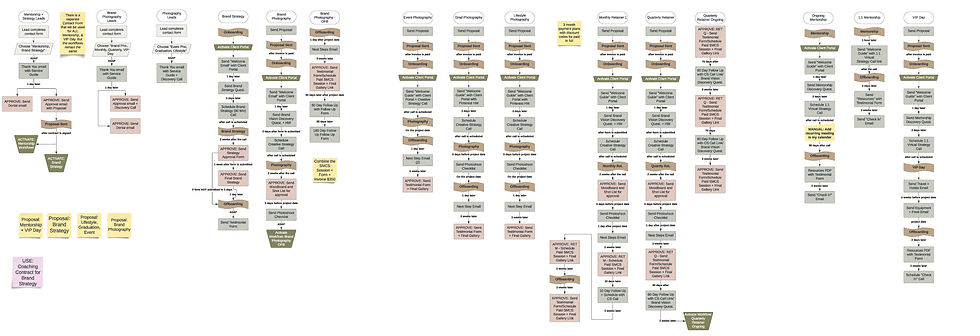
Sample Client Workflow Maps


Delivery Model: Three-Phase Approach
-
Phase 1: Discovery & Requirements Gathering (Weeks 1-3)
-
Assignment 1 - Details Questionnaire: Gathered all technical business details (contact form integration, contracts, meeting types and scheduling parameters, service descriptions, payment plans, current business pain points). I asked clients to select 1-3 issues from multiple-choice options like "not enough time," "need to hire but need systems first," "want to raise rates and need experience to justify it," so we could validate impact at project completion.
-
Assignment 2 - Process List Questionnaire: Requested line-by-line, step-by-step processes for delivering each service. I provided a linked Google Doc with examples showing the detail level needed ("1. New lead completes contact form, 2. I immediately send email asking to schedule call, 3. Client schedules and receives confirmation"). This revealed what could be automated, what emails were needed, what forms were required, and where steps could be combined. This assignment drove the evolution from "3 workflows" to "workflows for 3 services". Everyone had tiered packages where the same lead management and onboarding didn't work across all service levels.
-
Assignment 3 - Proposal & Service Guide Content Workbooks: Guided photographers through writing welcome messages, 4-step process overviews, FAQs with answers, payment policies, office hours, and extra fees. I provided examples alongside answer fields and specified what types of questions to include (for service guides: easy questions encouraging call bookings like general timeline and cost; avoid deal-breakers at this stage).
-
The 3-week homework deadline created strategic buffer for my team's regular tasks plus cushion days if clients needed to add missing questionnaire questions or service descriptions.
-
-
-
Phase 2: Strategy & Build Preparation (Weeks 4-6)
-
After homework submission, I reviewed Process List Questionnaires and created color-coordinated flowchart maps showing each workflow step: stage changes, emails sent, questionnaires submitted, scheduler links, calls scheduled. We held a 60-minute recorded Workflow Mapping Session to review these together. This call was critical, hidden needs surfaced here. Clients realized steps they'd forgotten, new questionnaires emerged, additional meeting types materialized.
-
The recording became source material for copywriters, who used it alongside flowcharts to craft all email templates. This ensured copy matched not just written homework but verbal descriptions of tone and approach. While copywriters drafted emails and designers created branded graphics, approval cycles happened 5 days before the VIP Weekend with 2-day client review and 3-day edit buffer.
-
-
Phase 3: The VIP Weekend Build (Weekend 6 Friday-Sunday)
-
Friday: The CRM specialist added all content to the platform, including emails, meeting types, proposals, questionnaires, contracts, and payment plans.
-
Saturday: Specialist built complete workflows connecting all pieces. Online Business Manager conducted mid-build review using detailed checklist, provided feedback. Specialist had 1+ hours post-feedback for corrections.
-
Sunday: I performed final quality review against comprehensive checklist. Recorded workflow overview video walking client through everything built and how workflows functioned. Delivered training video and Tutorial Vault access.
-
Workflow Architecture: Typical Structure
-
LM - Lead Management (Inquiry Workflow): Universal across service tiers. Managed hot leads from contact form submission. I often combined form completion with call scheduling so clients weren't bothered with separate "please schedule" emails. Leads received automated thank-you with service guide to review before free consultation.
-
ONB - Onboarding Workflow: First steps always identical: send proposal (allowing service/add-on selection), contract signature, first invoice payment. Immediately after payment submission, welcome/thank you email. Next: questionnaire or strategy call (or questionnaire first, then call one week later to discuss answers). Then branched into service-specific processes.
-
Service-Specific Process Workflows: Named after service ("Branding Session Process," "Wedding Day Workflow"). Handled everything between onboarding and offboarding: shot list questionnaires, location scouting, wardrobe planning, day-of coordination.
-
OFB - Offboarding Workflow: Final deliverables sent, followed by testimonial requests. Branding photographers often included 6-month follow-up offering content refresh packages. Wedding photographers sent 1-year anniversary emails. These long-game touchpoints converted one-time clients into repeat business.
-
Project Stage Customization: Customized project stages in both platforms integrated with workflows. Photographers could see at a glance: new leads, proposals sent, contracts signed, retainers paid, clients in onboarding/in progress/offboarding/long-game follow-ups.
Tools & Systems
-
ClickUp: Central project management with templated task lists, subtasks, custom fields, due dates per client project
-
Slack: Real-time team communication and client questions (replaced early ClickUp client access attempts)
-
Zapier: Automated client onboarding, triggered on payment to create Google Drive folders, Slack channels, ClickUp projects, delayed $10 Starbucks gift card
-
HoneyBook/Dubsado: Client-selected CRM platform for workflow implementation
-
Google Drive: Deliverable organization and file sharing
Leadership, Risk & Decision-Making
My Role & Responsibilities
-
Client Relationship Management: Sole client-facing team member for all sales, discovery, strategy, and delivery
-
Requirements Translation: Converted client homework and verbal descriptions into visual workflow maps and technical specifications
-
Team Coordination: Managed 8-person contractor team (3 CRM specialists, 2 designers, 2 copywriters, 1 OBM) across multiple concurrent client projects
-
Quality Assurance: Final review authority on all client deliverables before handoff
-
Strategic Decision-Making: Scope negotiations, timeline enforcement, process evolution based on patterns across implementations

View of the HoneyBook Build Checklist

View of Support Ticket Submission Form
Key Challenge: Scope Creep from Hidden Needs
-
Risk:
-
Clients signed up for "3 workflows" but Workflow Mapping Sessions revealed they actually needed 5-6. During the call, new questionnaires surfaced, additional calls materialized, steps never written in Process List emerged. For example, a client might mention a pre-shoot planning call requiring a wardrobe questionnaire, never documented in homework. Now I needed the questions, meeting parameters, and timeline placement.
-
I had three choices: include extra workflows free (hurting profitability), help them prioritize down to three (leaving system gaps), or invoice for additional workflows (feeling like bait-and-switch).
-
-
-
Decision:
-
I implemented multiple protective measures:
-
Built 3-week homework buffer allowing clients time to add missing questionnaire questions or service descriptions without derailing timeline
-
Established strict contract-protected deadlines with clear consequences (late homework automatically pushed VIP Weekend to next available date)
-
Sent reminder emails 1 week and 3 days before homework due date explaining consequences
-
One-week reminder included 24-hour extension request option with no penalty (life happens)
-
Late twice without prior notice triggered postponement fee on next invoice payment
-
Eventually restructured from workflow-based pricing ("3 workflows for $1,600") to service-based pricing ("workflows for 3 complete services at $2,500"), eliminating the arbitrary workflow limit
-
-
-
Tradeoff:
-
Stricter contracts and pricing evolution required clearer client education upfront but protected both profitability and quality. The service-based model better aligned with real business needs.
-
Timeline Protection: Postponement Fee Structure
-
Risk:
-
VIP Weekends scheduled in January but not completed by March created open projects lingering on team books indefinitely.
-
-
Decision:
-
If project wasn't completed within 3 months of original date, I offered two options: 50% refund or postponement fee to continue.
-
-
Impact:
-
This also addressed service version updates. Clients who signed up for "Version 1.0" in January but didn't start until April when "Version 3.0" offered more deliverables still received Version 1.0—unless they paid the price difference. This prevented early adopters from benefiting from delays while later clients paid more for enhanced services.
-
Quality Control: Multi-Tier Review System
-
I positioned myself as the final quality checkpoint, recognizing "no one was going to care more about my business and reputation than me." The review process:
-
CRM specialist self-review using detailed checklist
-
OBM review Saturday afternoon with documented feedback in ClickUp
-
My final review Sunday with comprehensive checklist before client delivery
-
Key Decision: Communication Hub Strategy
-
Decision:
-
I intentionally kept contractors working independently rather than cross-communicating. I served as the central hub for all information flow.
-
-
Reasoning:
-
In group calls everyone was collaborative, but I learned from previous projects that different work ethics and communication styles could create friction in direct exchanges. By centralizing communication, I maintained control over dependencies and could ensure Step 1 completion before greenlighting Step 2.
-
-
Tradeoff:
-
This increased my workload but gave me complete visibility and control over the critical path, preventing bottlenecks.
-
Outcomes & Impact
Quantitative Results
View of the onboarding workflow for ALL VIP Weekend Clients
15+
hours per week saved on administrative tasks
~20
emails automated per client (avg. 5 per workflow)
120+
implementations completed using this refined methodology
Qualitative Outcomes
-
Professional appearance that justified premium pricing ($3-6.5K services)
-
Fewer client questions about process and progress
-
Some photographers booked new clients specifically because of polished proposal and lead management experience
-
Ability to scale operations (hire team members, take on more clients)
-
Confidence to raise rates knowing client experience matched pricing tier

Client Testimonials

"My struggles are no more. I have already been told that they have NEVER received such a detailed and professional proposal from any photographer. I even had one person book me from my response time and the overall look alone. The client said if I'm doing this BEFORE they even pay me they already know their experience is going to be amazing."
— Jasmine Smith, Branding & Wedding Photographer

"I have a solid workflow that works effortlessly, and I'm confident in how I onboard my clients. I'm in the middle of a rebrand, and I want to wow my clients with my process and communication, and I want it to be a minimal effort on my part - I can now!"
— Ariel Burns, Brand Photographer

"I finally realized that I was never going to do it because it wasn't something I was good at doing. I loved how professional Kelli was and how she put my mind at ease that all of my mess wasn't too much to handle! She was so professional, on top of it with her communication and just a complete lifesaver!!! Truly appreciate Kelli!"
— Jalecia Ates, Photographer

"I complained to a friend about not having time to do anything and she referred me to Kelli. I just wanted to have the freedom to LIVE. The process from start to finish was organized, well-thought-out, and easy for me to understand. Kelli was very professional, forthcoming, and accommodating. Take the leap! It's worth it!"
— Kimberly, Makeup Artist & Photographer
Comparison to Original Goals
-
Goal: Save 15-20 hours per week on administrative tasks
-
Result: Consistently achieved across all implementations through automation
-
-
Goal: Create professional experience justifying premium pricing
-
Result: Clients reported booking conversions directly attributed to polished proposals and professional communication
-
-
Goal: Enable scaling without system breakdown
-
Result: Photographers successfully added team members and increased client capacity
-
Key Takeaways & PM Skills Demonstrated
Project Management Competencies Applied
-
Requirements Gathering: Developed structured 3-assignment homework system extracting detailed business processes and translating them into technical specifications
-
Process Mapping: Converted complex verbal descriptions into visual workflow diagrams that both clients and technical teams could understand
-
Scope Management: Implemented contract protections, service restructuring, and postponement fees to prevent scope creep while maintaining client satisfaction
-
Timeline Management: Built strategic 3-week buffers with clear deadline enforcement protecting both client needs and team capacity
-
Quality Assurance: Designed multi-checkpoint review process (specialist → OBM → final review) ensuring consistent deliverable quality
-
Team Coordination: Managed 8 contractors across concurrent projects using centralized communication hub strategy
-
Process Optimization: Created template banks and Tutorial Vault for scalable knowledge transfer across 44+ implementations
What I Learned & Improved
Objective Work Clarity
Coming from graphic design and branding where feedback is subjective ("I don't like this shade of blue"), building systems and workflows was refreshingly objective. It either works or it doesn't. Issues can be clearly seen and fixed. This clarity enabled consistent results across diverse clients.
Service Evolution Through Pattern Recognition
The shift from workflow-based to service-based pricing came from recognizing patterns across implementations, clients with tiered services always needed more workflows than the artificial "3 workflow" limit. Listening to these patterns drove product improvement.
Communication Hub Value
Serving as central communication point between contractors increased my workload but prevented dependency bottlenecks. In small team environments, this centralized coordination is often more efficient than distributed collaboration.
How This Informed Future Projects
Refining this process across 120+ implementations taught me that truly scalable services require three elements: repeatable methodology (the 3-phase approach), customization flexibility (no two photographers were identical), and protective boundaries (contracts, timelines, scope definitions). The VIP Weekend succeeded not because it was a template, but because it was a framework that adapted to individual needs while maintaining quality standards.
Most importantly, this work reinforced that working with women of color pursuing their passions and building businesses during COVID, a time when that was harder than ever, made the systems work meaningful beyond deliverables. These weren't just projects; they were contributions to entrepreneurs showing up as their best selves.